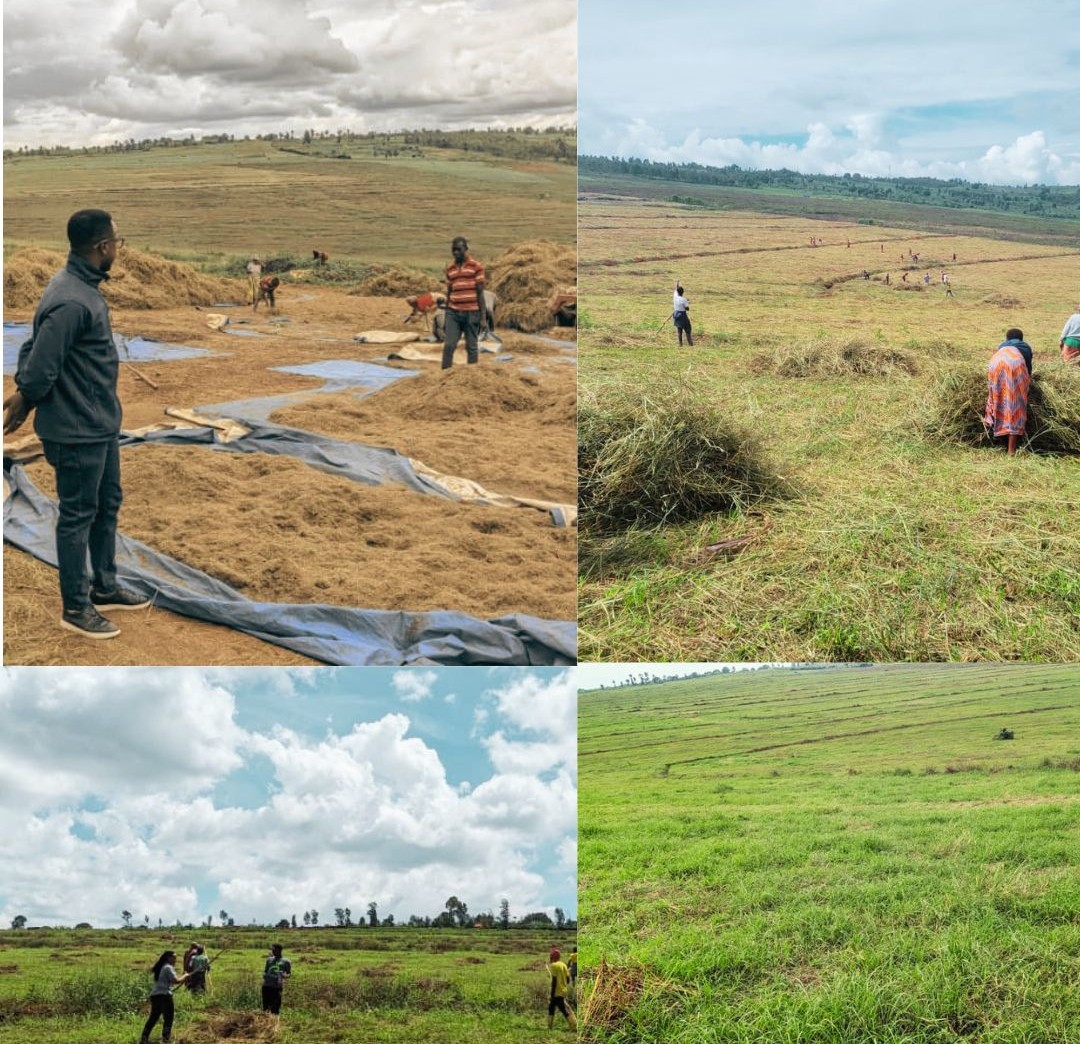
Acquiring practical knowledge from short courses is an important step, but transforming that knowledge into tangible results is what truly sets visionary youth apart from those who simple wait for the opportunities. This is what characterized the members of PYAM, a youth company made up of 29 young men and 21 young women, a total of 50, operating in Kayonza District, Mwiri Sector, Nyawera Cell.
This company was established in 2022 after its members completed a short-term training course in irrigation, with the aim of transforming their knowledge into practical activities in the agriculture sector.
Initially, PYAM started providing irrigation services to farmers, but later saw an opportunity in the area where it operates, which is characterized by livestock farming, fodder shortages, especially during the dry season due to climate change.
That is where the decision to enter the professional grass farming business came from, with the aim of solving the problem of grass shortage and making it easier for farmers to get animal feed at a good price.
In an interview with Eric Murenzi, the director of PYAM said that their desire was to provide a lasting solution to the problem of farmers in their area.
“We operate in an area that is very livestock-oriented but there is a serious problem of fodder shortage, especially during the dry season. We decided to enter the grass farming business to help farmers get animal feed that is easily available and at a good price,”.
Through a partnership with the Rwanda Agricultural Board (RAB) and the Rwanda Dairy Development Project (RDDP), PYAM secured access to 52 hectares of land provided by RAB as a starting point for their initiative 52 hectares of RAB land as a starting point for the project.
While it was a great opportunity, utilizing and producing such a large area required commitment, strong leadership and the commitment of the members.
Eric Murenzi explains that the journey to manage such a large land area required a clear vision.
“Managing such a large land area requires commitment, commitment from the members and a clear vision of where you want to go. That is what kept us going until we started to see results,”.
In starting the hay farming business, PYAM did not choose to grow hay in the traditional way. Instead, they chose a type of hay based on the nutrients that the animals need.
Chloris and Brachiaria were grown as energy-giving grasses, while Mukuna and Desmodium were selected to help livestock obtain nutrients that build their bodies.
“Just as humans need immunity, energy and nutrients, so too do livestock. We chose Chloris and Brachiaria as energy-giving grasses, while Mukuna and Desmodium help them obtain nutrients that build their bodies,” Murenzi explains.
The harvest journey began in September 2025, when they began by preparing the field, purchasing seeds and fertilizers, and planting the corn. This was followed by weeding and erosion control measures to protect the soil and increase yields.
In March 2026, PYAM began its first professional harvest.
So far, they have sold 26 trucks of fresh fodder to Nandi Farm, have 4 tons of Chloris hay, and are building a hangar to store hay for the dry season.
Murenzi says their vision is not just to farm, but to build a sustainable market.
“We currently sell to Nandi Farm, but next season we want to start farming under contract so that the produce has a destination before harvest,”.
Beyond boosting livestock productivity, PYAM has also become a source of employment for the youth in the area where it operates.
Every day, its operations employ between 100 and 400 people, of which at least 70% are youth. This has made this project not only a solution to livestock farming, but also a channel for entrepreneurship and improving the lives of the youth.
Despite their achievements, PYAM still faces challenges including the lack of baling machines, as those available on the market are very expensive, and the lack of water for irrigation.
This prevents them from using their irrigation skills to farm all year round.
“We have learned about irrigation, but so far there is not enough water in our area. In the future, we want to use irrigation and introduce hydroponic fodder so that we can farm all year round,”.
In the future, PYAM aims to expand its land area and add technology to its grass-roots farming.
PYAM’s story shows that short-term training can be the beginning of a big change, when visionary youth choose to turn knowledge into action. From irrigation courses to job creation and solving the grass-roots problem, these Kayonza youth are showing that agriculture can be a path to development and a sustainable solution for their communities.
Jean Bernard MUKUNDENTE/ RYAF Communication and PR
Email:b.mukundente@ryaf.rw/ ryafcommunication@gmail.com