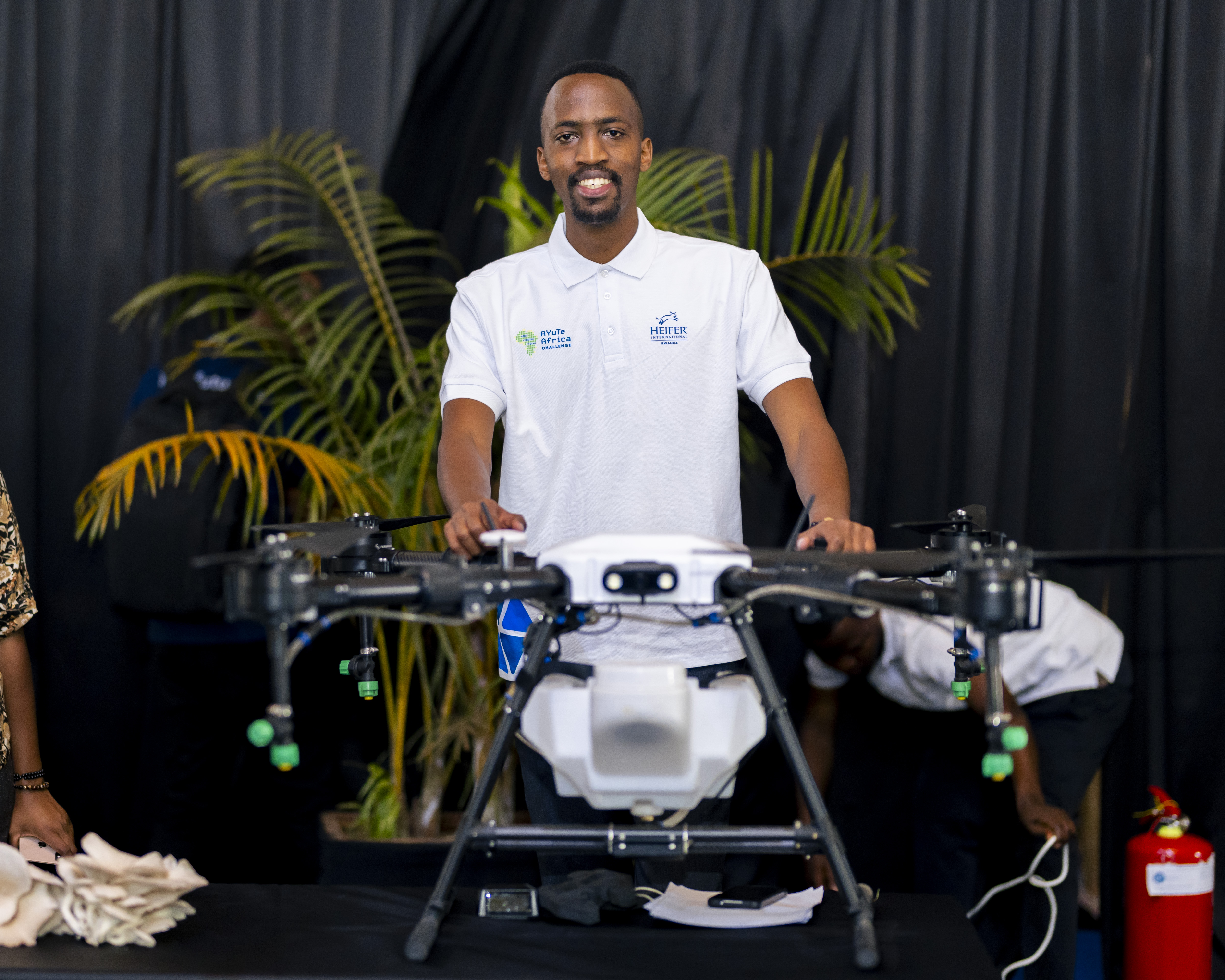
In 2024, Muyombano Happy Axel co-founded Ampere Vision Rwanda, embarking on a journey into agritech and drone technology. This journey was inspired by his close relationship with farmers and the challenges they face due to agricultural loss. He saw firsthand through his upbringing how much time, energy and effort went into growing crops but how many crops would not make it from farmer to market. A good example of this challenge is when almost all cereal crops were lost in Huye District, Rwanda in 2017, and through this experience, along with a desire to learn more about drones through school, he began to build a vision for future solutions.
His solution is based around solving the problem of pre-harvest loss of crops due to pests/diseases and the use of costly but inefficient applications of pesticides and foliar fertilizers by farmers. Farmers have to endure two burdens here - they have to pay for both the cost of the inputs and the loss of yield.
Farmers in Rwanda currently use knapsack sprayers to apply pesticides to their fields, and since this method requires farmers to be on foot while carrying their tanks, this represents a time-consuming inefficient means of applying chemical pest control to their fields. By the time a farmer finishes spraying his/her entire farm, the insect pressure on the crops will have increased due to the time delay from the first area sprayed to the last area sprayed. Also, the overuse of chemicals, drift from pesticide applications, and extended exposure of the operator presents considerable environmental and health risks to Rwandan farmers.
Ampere Vision Rwanda has created drone precision agricultural spraying technologies to address these challenges. The drones hover above crop canopies at controlled heights and speeds spraying a fine mist of either pesticides or foliar fertilisers exactly where it is needed. This improves coverage, wastes less product and is safer to apply, as well as dramatically decreases time spent on labour.
Despite its potential, the innovative process has faced multiple obstacles, including technical complexity, regulatory approval, high cost of equipment, and farmers' initial scepticism. According to Axel Muyombano trust was one of the largest obstacles to overcome:
"In terms of building trust with the technology, there was a lot of genuine concern with having an unmanned aerial vehicle flying above your fields. Farmers systematically asked if our technology worked, and through public demonstration events we've made it a point to show them that it in fact did work. We have also partnered with co-operatives to allow for farmer-to-farmer communications regarding our service."
This hands-on demonstration method has helped with adoption and trust in the farming community.
The major distinction between drone application and traditional methods is precision. Unlike traditional application methods, drones use the right amount of product, applied in the right location and at the right time to reduce costs, lower environmental damage, improve, efficiency and minimise the amount of time that farmers are in contact with the chemicals they utilise.
Farmers have already been experiencing some positive impacts from the new technology; for example, members of the KOUBITE cooperative in Kamonyi District have found their input costs lower and their pre-harvest losses reduced as a result of using the improved methods to control insects and diseases affecting their crops. The result has been improved crop yields, as well as greater income potential before they actually harvest their crop.
Ampere Vision Rwanda is currently using one 10l drone to successfully deliver cooperative memberships to 107 smallholder farmers. They are looking to expand their service delivery to reach even more cooperative members, as well as deliver to those smallholding farmers in more remote locations and provide last-mile service delivery by scaling up to three drones, two of which will be 40l drones, with help from the AYuTe Challenge funding.
By developing strategic partnerships with Heifer International Rwanda, YARA, and Hello Tractor they are able to provide farmers with a bundled service model that includes drone spraying, foliar fertilizer application, and mechanization services at an affordable price.
The award of second runner-up in the AYuTe Challenge, as well as the prize of RWF 15 million, represents validation for our efforts and a new opportunity for growth. We will be using the funding to support the growth of our business and strengthen our relationships with partners. This will enable us to provide more farmers throughout Rwanda access to the services and products that we offer.
In the next three to five years, we see ourselves expanding further within Rwanda and into the East African region. Additionally, we will continue to work towards providing precision agriculture through the integration of drone imagery and data analytics to deliver real-time information on crop health.
In speaking with young innovators, Muyombano Happy Axel stressed that innovators take action instead of striving for perfection, ultimately pushing all youth to create prototypes, test their concepts, receive feedback, and improve their solutions to address the issues faced in their communities.
Jean Bernard Mukundente/ RYAF Communication and PR
Email:b.mukundente@ryaf.rw / ryafcommunication@gmail.com